Tamil Family Relationship Words Explained: A Complete Guide
Tamil Family Relationship Words Explained: A Complete Guide
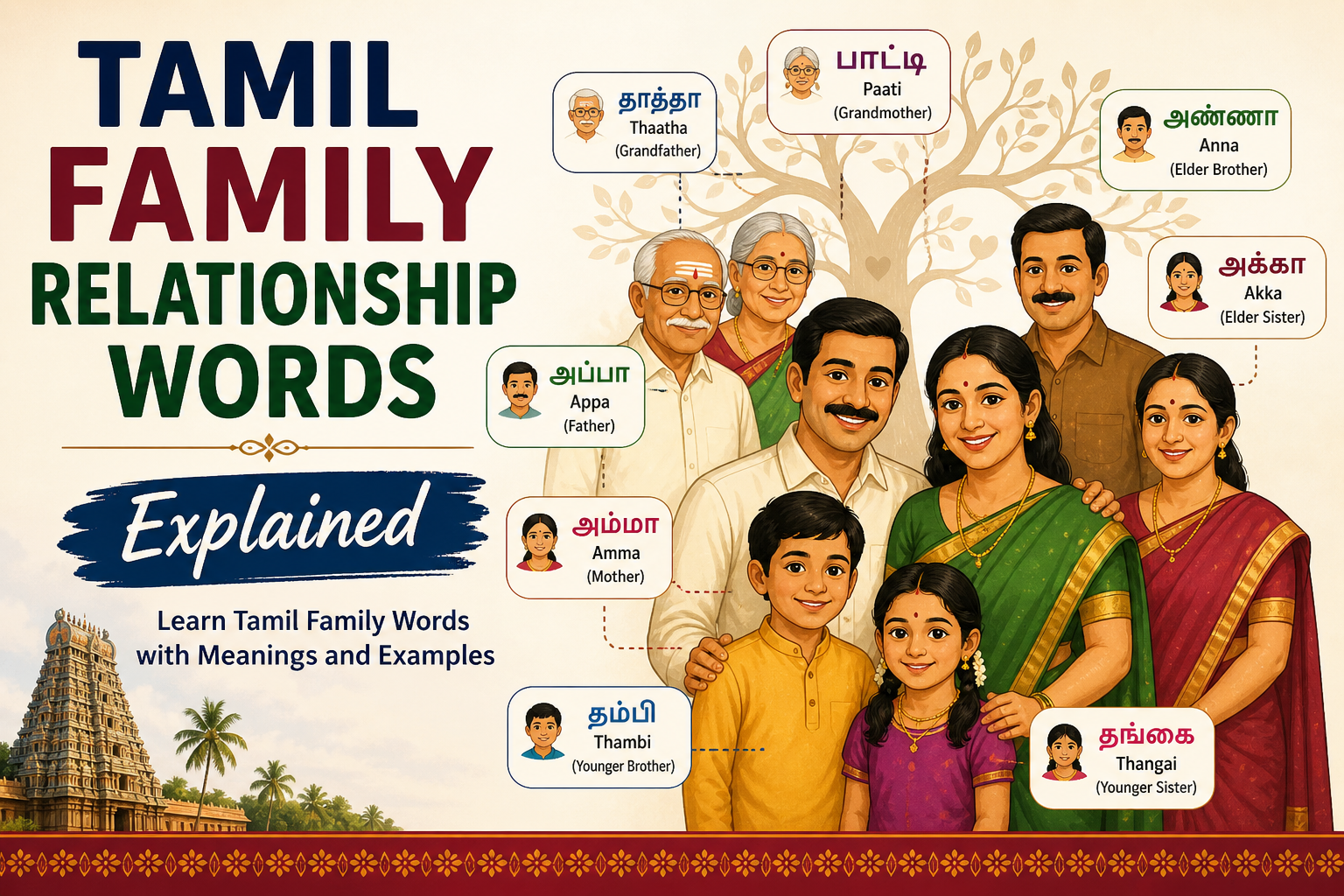
Excerpt: Tamil has a rich and detailed system of family relationship words. Unlike English, Tamil often uses different words for elder and younger siblings, father’s side and mother’s side relatives, and even specific types of uncles and aunts. This guide explains the most common Tamil family relationship words with Tamil script, pronunciation, meaning, and usage examples.
Family is one of the most important parts of Tamil culture. Whether you are learning Tamil, speaking with Tamil relatives, watching Tamil movies, or trying to understand traditional Tamil family conversations, knowing relationship words is extremely useful. Tamil family words are more detailed than English family terms because they often show age, respect, generation, and whether the person is from the father’s side or mother’s side.
In English, one word like “uncle” can describe many different people. But in Tamil, your father’s elder brother, father’s younger brother, mother’s brother, and aunt’s husband may all have different names. This makes Tamil relationship vocabulary very expressive and culturally meaningful. For more basic vocabulary, you may also read our guide on learning Tamil basics and common Tamil greetings.
Basic Tamil Family Words
Let us begin with the most common Tamil family words. These are the words you will hear almost every day in Tamil-speaking homes.
| English | Tamil | Pronunciation |
|---|---|---|
| Family | குடும்பம் | Kudumbam |
| Relative / Relationship | உறவு | Uravu |
| Mother | அம்மா | Amma |
| Father | அப்பா | Appa |
| Child | பிள்ளை | Pillai |
| Son | மகன் | Magan |
| Daughter | மகள் | Magal |
Amma and Appa are affectionate everyday words. More formal words also exist. For example, தாய் “Thai” means mother, and தந்தை “Thanthai” means father. These formal words are often used in writing, speeches, songs, and respectful contexts.
Tamil Words for Brothers and Sisters
Tamil makes a clear difference between elder and younger siblings. This is one of the most important differences between Tamil and English family vocabulary.
| English | Tamil | Pronunciation |
|---|---|---|
| Elder brother | அண்ணா | Anna |
| Elder sister | அக்கா | Akka |
| Younger brother | தம்பி | Thambi |
| Younger sister | தங்கை | Thangai |
These words are not only used for real brothers and sisters. In Tamil culture, people often use Anna, Akka, Thambi, and Thangai respectfully for cousins, neighbors, friends, and even strangers. For example, a younger person may call an older shopkeeper “Anna” or “Akka” as a polite and friendly form of address.
Grandparents in Tamil
The common Tamil words for grandparents are simple and widely used.
| English | Tamil | Pronunciation |
|---|---|---|
| Grandfather | தாத்தா | Thaatha |
| Grandmother | பாட்டி | Paati |
Tamil normally uses Thaatha and Paati for both paternal and maternal grandparents. If someone needs to be specific, they may say Appa vazhi thaatha, meaning grandfather from the father’s side, or Amma vazhi paati, meaning grandmother from the mother’s side.
Father’s Side Relatives in Tamil
Tamil has very specific words for relatives from the father’s side. This is where Tamil family vocabulary becomes more detailed.
| Relationship | Tamil | Pronunciation | Meaning |
|---|---|---|---|
| Father’s elder brother | பெரியப்பா | Periyappa | Literally “big father” |
| Father’s younger brother | சித்தப்பா | Chithappa | Younger paternal uncle |
| Father’s sister | அத்தை | Athai | Paternal aunt |
| Father’s elder brother’s wife | பெரியம்மா | Periyamma | Wife of Periyappa |
| Father’s younger brother’s wife | சித்தி | Chithi | Wife of Chithappa |
The word Periyappa comes from periya, meaning big or elder, and appa, meaning father. So, it gives the feeling of an elder father figure. Similarly, Chithappa refers to the father’s younger brother. These words show respect and closeness at the same time.
Mother’s Side Relatives in Tamil
Tamil also has special words for relatives from the mother’s side. Some words may overlap with father’s side terms depending on region, family custom, and spoken dialect.
| Relationship | Tamil | Pronunciation | Meaning |
|---|---|---|---|
| Mother’s brother | மாமா | Maama | Maternal uncle |
| Mother’s brother’s wife | மாமி | Maami | Maternal uncle’s wife |
| Mother’s elder sister | பெரியம்மா | Periyamma | Elder maternal aunt |
| Mother’s younger sister | சித்தி | Chithi | Younger maternal aunt |
Maama is one of the most commonly heard Tamil relationship words. It usually means mother’s brother. However, in everyday speech, it can also be used in a friendly or humorous way for certain male relatives or familiar older men. Context is very important in Tamil.
Common Tamil Words for Husband, Wife, and Marriage Relations
Tamil has formal, polite, and colloquial words for marriage relationships. The exact word used depends on the setting. Some words are more suitable for writing, while others are common in speech.
| English | Tamil | Pronunciation |
|---|---|---|
| Husband | கணவர் | Kanavar |
| Wife | மனைவி | Manaivi |
| Marriage | திருமணம் | Thirumanam |
| Bridegroom / Son-in-law | மாப்பிள்ளை | Maappillai |
| Daughter-in-law | மருமகள் | Marumagal |
| Father-in-law | மாமனார் | Maamanaar |
| Mother-in-law | மாமியார் | Maamiyaar |
The word Maappillai is commonly used for a bridegroom and also for a son-in-law. In Tamil weddings, you may hear people say “Maappillai” many times when referring to the groom. The word Marumagal usually means daughter-in-law, but in some contexts, related forms may also be used for niece-like relationships. Because Tamil kinship words can depend on family structure, context is always important.
Brother-in-Law and Sister-in-Law Words in Tamil
In-law relationships can be more complex in Tamil. Some words change depending on whether the relationship comes through the husband, wife, elder brother, younger brother, or sister.
| Relationship | Tamil | Pronunciation | Usage |
|---|---|---|---|
| Elder brother’s wife | அண்ணி | Anni | Sister-in-law |
| Sister’s husband / Wife’s brother / familiar brother-in-law | மச்சான் | Machaan | Common spoken word |
| Brother-in-law | மைத்துனர் | Maithunar | More formal word |
| Sister-in-law | மைத்துனி | Maithuni | More formal word |
Machaan is very common in spoken Tamil. It can mean brother-in-law, but it is also used casually among male friends in some regions. This is why Tamil learners should pay attention to tone, relationship, and situation when hearing the word.
Cousins in Tamil
English has one simple word: cousin. Tamil often describes cousins based on the exact family connection. Instead of using one general word, Tamil speakers may say whose son or daughter the person is.
| English Meaning | Tamil Expression | Pronunciation |
|---|---|---|
| Uncle’s son | மாமா மகன் | Maama magan |
| Uncle’s daughter | மாமா மகள் | Maama magal |
| Aunt’s son | அத்தை மகன் | Athai magan |
| Aunt’s daughter | அத்தை மகள் | Athai magal |
In daily conversation, many Tamil speakers simply call cousins Anna, Akka, Thambi, or Thangai depending on age. For example, an older male cousin may be called Anna, and an older female cousin may be called Akka. This shows respect and makes the relationship feel closer.
Nephew and Niece in Tamil
Tamil words for nephew and niece can vary depending on the exact relationship. However, these are commonly understood words:
| English | Tamil | Pronunciation |
|---|---|---|
| Nephew | மருமகன் | Marumagan |
| Niece | மருமகள் | Marumagal |
These words can also mean son-in-law and daughter-in-law in other contexts. Because of this, the meaning depends on the situation. Tamil is a language where family context matters greatly.
Respectful Use of Tamil Family Words
Tamil family words are not used only inside the family. They are also used as respectful social words. For example, calling someone Anna or Akka can be a polite way to speak to a slightly older person. Calling an elderly woman Paati or an elderly man Thaatha can show affection and respect.
This style of speaking reflects Tamil culture, where age and relationship are important in communication. Instead of calling everyone by name, Tamil speakers often use relationship words to show warmth, respect, and social closeness.
Regional and Spoken Variations
Tamil is spoken in Tamil Nadu, Sri Lanka, Malaysia, Singapore, and many other places around the world. Because of this, pronunciation and usage can change slightly from region to region. Sri Lankan Tamil, Indian Tamil, and Malaysian Tamil may use some words differently. Some families may also have their own preferred terms.
For example, one family may use Chithi for mother’s younger sister, while another may use a slightly different pronunciation. Some people say Paati, while others pronounce it closer to Patti. These differences are normal and part of the richness of Tamil.
Example Sentences Using Tamil Family Words
- Amma veetil irukkiraal. — Mother is at home.
- Appa velaiyukku ponaar. — Father went to work.
- Anna enakku uthavi seithaar. — Elder brother helped me.
- Akka samayal seigiraal. — Elder sister is cooking.
- Thaatha kathai sonnaar. — Grandfather told a story.
- Paati saapadu seithaal. — Grandmother prepared food.
- Maama naalai varuvaar. — Uncle will come tomorrow.
Quick Tamil Family Vocabulary List
- Amma — Mother
- Appa — Father
- Anna — Elder brother
- Akka — Elder sister
- Thambi — Younger brother
- Thangai — Younger sister
- Thaatha — Grandfather
- Paati — Grandmother
- Periyappa — Father’s elder brother
- Chithappa — Father’s younger brother
- Athai — Father’s sister
- Maama — Mother’s brother
- Maami — Mother’s brother’s wife
- Periyamma — Elder aunt
- Chithi — Younger aunt
- Kanavar — Husband
- Manaivi — Wife
- Maamanaar — Father-in-law
- Maamiyaar — Mother-in-law
- Maappillai — Bridegroom / Son-in-law
- Marumagal — Daughter-in-law / Niece, depending on context
Conclusion
Tamil family relationship words are more than simple vocabulary. They show respect, age, family structure, closeness, and cultural values. Words like Amma, Appa, Anna, and Akka are easy to learn, but Tamil also has many detailed terms for uncles, aunts, cousins, and in-laws.
The best way to learn Tamil relationship words is to understand the family connection behind each term. Instead of memorizing only English meanings, try to learn which side of the family the word belongs to and whether the person is elder or younger. Once you understand this system, Tamil family vocabulary becomes much easier and more meaningful.
Whether you are learning Tamil for family, travel, culture, movies, or personal interest, these relationship words will help you understand Tamil conversations more naturally. To continue learning, explore our guides on Tamil vocabulary, Tamil names and meanings, and spoken Tamil phrases.