The History of Bamini: The Legacy Font That Shaped Tamil Desktop Publishing
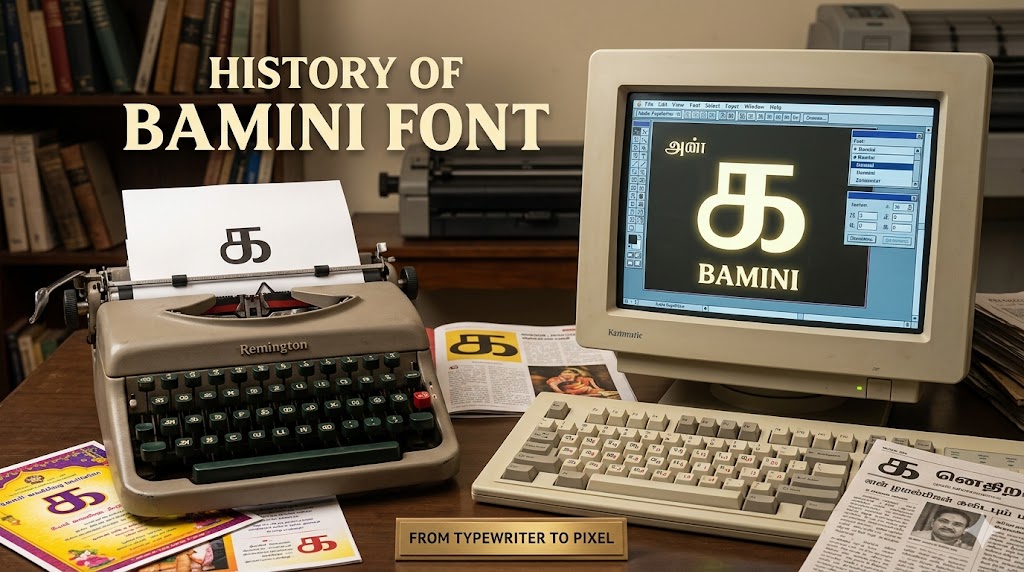
If you have ever received a Tamil wedding invitation, read a locally printed Tamil magazine, or visited a desktop publishing (DTP) shop in Sri Lanka or Tamil Nadu, you have almost certainly laid eyes on the Bamini font.
Before the internet era and the standardization of Unicode, typing complex scripts like Tamil on a computer was a massive technological hurdle. Bamini was one of the earliest and most successful solutions to this problem, serving as a vital bridge between mechanical typewriters and the digital age.
Here is the story of how the Bamini font became the undisputed king of Tamil print.
The Pre-Unicode Problem
In the 1980s and early 1990s, personal computers were built entirely around the English alphabet and the ASCII character set. There was no universal system (like today's Unicode) to tell a computer how to render the 247 characters of the Tamil language.
To solve this, early software developers used a clever "hack." They replaced the visual designs of English letters in a font file with Tamil characters. For example, pressing the f key wouldn't produce an 'f', but rather the Tamil letter க (Ka).
Bamini was born out of this era. It is a legacy, non-Unicode font, meaning the computer still "thinks" you are typing in English, but the font visually tricks the screen and the printer into displaying Tamil.
The Typewriter Connection
What made Bamini so universally adopted over other early Tamil fonts? The answer lies in its keyboard layout.
Before computers, government offices, newsrooms, and businesses relied on mechanical Tamil typewriters. The creators of the Bamini layout smartly mapped the computer keys to closely mimic the physical layout of these traditional typewriters.
Furthermore, Bamini relies on visual typing rather than logical typing.
-
In modern Unicode (Logical): You type the consonant
கand then the vowel soundிto getகி. -
In Bamini (Visual): Just like a physical typewriter, if a vowel curve appears before the letter visually (like
ெinபெ), you have to type the vowel curve first, and then the consonant.
Because it mirrored the mechanical typewriter experience, an entire generation of professional typists could transition to computers without having to relearn how to type.
The Golden Age of Desktop Publishing
Throughout the 1990s and 2000s, Bamini became the absolute standard for Tamil desktop publishing, particularly in Sri Lanka where it remains the default standard for traditional print media to this day.
Graphic designers and layout artists loved it because it worked flawlessly in software like Adobe PageMaker, CorelDRAW, and early versions of Photoshop, which initially struggled with complex Unicode text rendering.
If a newspaper was printed, a banner was designed, or a book was published in Tamil during this era, there is a very high probability that it was typed using the Bamini layout.
The Shift to Unicode
As the internet grew, the "Bamini hack" revealed its flaws. Because a computer running Bamini thinks it's reading English letters, if you copy and paste Bamini text into a web browser or an email without the font installed, it turns into unreadable English gibberish (e.g., vd; ngah; instead of என் பெயர்).
To make Tamil searchable and universally readable on the web, the world moved to Unicode—a standard where every Tamil character has a unique, permanent digital code. Fonts like Latha, Katha, and Google's Noto Sans Tamil took over the digital space.
Bamini’s Enduring Legacy Today
Despite being technically obsolete for web design and app development, Bamini refuses to die.
-
The Print Industry: Local print shops and DTP centers still heavily rely on Bamini because their vast archives of old documents, templates, and layouts are all saved in this format.
-
Aesthetic Appeal: The classic, slightly bold, and highly legible aesthetic of the original Bamini font is still considered the "gold standard" for official printed documents.
-
Conversion Tools: Today, a massive ecosystem of "Bamini to Unicode" and "Unicode to Bamini" converter tools exists online, allowing modern writers to type in Unicode, but convert their text back to Bamini for printing.
-
Modern Keyboards: Software like Keyman offers "Suratha Bamini" layouts, allowing veteran typists to use the Bamini keyboard strokes they have memorized to output modern Unicode text.
Bamini is more than just a typeface; it is a piece of digital heritage. It paved the way for Tamil computing, ensuring that one of the world's oldest classical languages could successfully make the leap from paper to the pixel.